THE PHYSIOPH JOURNAL
The Crack Is Not a Diagnosis
Chiropractor vs physiotherapist in the Philippines: learn the risks of spinal manipulation, real reported complications, regulation differences, and why licensed physical therapy matters.
Chiropractic, Physiotherapy, and What Filipino Patients Need to Know
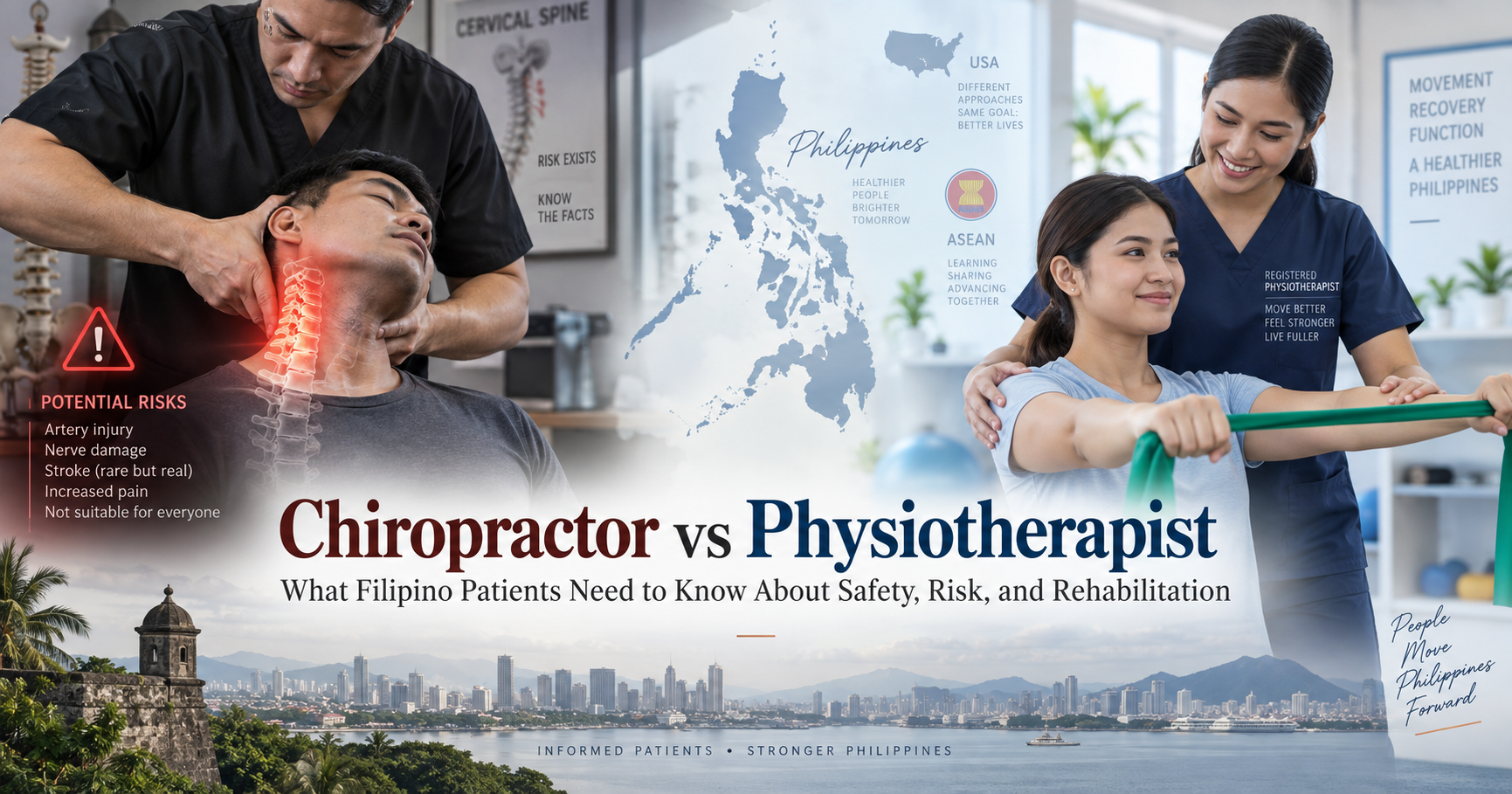
In the Philippines, a person with back pain can see advertisements for spinal adjustments, posture correction, “alignment,” rehabilitation, massage, physical therapy and chiropractic care—sometimes all on the same social-media feed.
To an ordinary patient, these services may look similar.
They are not necessarily the same.
The difference becomes especially important when someone is experiencing neck pain, back pain, numbness, weakness, headaches or an injury and is deciding who should evaluate the problem.
Chiropractic care has become increasingly visible around the world. In the United States, where national statistics are available, chiropractic use among adults increased from 7.4% in 2002 to 11.0% in 2022. Among U.S. adults who used chiropractic care in 2022, 85.7% reported using it for pain management.[1]
Comparable national statistics showing how many Filipinos use chiropractic care are not readily available in the government and peer-reviewed sources reviewed for this article. That means claims that chiropractic use is rapidly increasing in the Philippines should not be presented as a proven national trend without reliable Philippine data.
What we can establish is more important: physical therapy and chiropractic do not currently have the same regulatory position in the Philippines.
The Philippine Situation: Physical Therapy Is a PRC-Regulated Profession
In the Philippines, the official professional title is generally Physical Therapist, although the term physiotherapist is commonly used internationally for the same profession.
Physical therapy is regulated under Republic Act No. 5680, the Philippine Physical and Occupational Therapy Law.[2]
The law defines physical therapy as treatment involving therapeutic exercise and physical agents, including manual techniques. The profession is overseen through the Professional Regulation Commission, or PRC.
As of 2026, Physical Therapy appears among the PRC's Professional Regulatory Boards. The PRC also continues to conduct the Physical Therapists Licensure Examination.[3][4]
This means that a person representing himself or herself as a licensed Philippine physical therapist is part of a statutory national professional-regulation system involving educational requirements, examination, registration and professional accountability.
The PRC's current list of 46 Professional Regulatory Boards includes Physical Therapy.
Chiropractic does not appear on that PRC list.[3]
No separate PRC Professional Regulatory Board for Chiropractic or PRC chiropractic licensure examination appears in the PRC's current professional-board and examination listings reviewed for this article.
This distinction needs to be stated carefully.
It does not automatically mean that offering chiropractic services in the Philippines is illegal. It means that chiropractic and physical therapy should not be presented to Filipino consumers as though they currently have an identical PRC licensing structure. They do not.
How Does That Compare With the United States?
The situation in the United States is different.
In the U.S., both chiropractors and physical therapists are licensed healthcare professions.
According to the U.S. Bureau of Labor Statistics, every U.S. state requires chiropractors to be licensed. Chiropractors typically complete a Doctor of Chiropractic, or D.C., program and must satisfy state licensing requirements.[5]
Physical therapists are also required to be licensed in every U.S. state. Entry into the profession generally requires a Doctor of Physical Therapy, or DPT, degree.[6]
This is an important distinction for Filipinos who encounter American chiropractic content online.
A statement such as “chiropractors are licensed healthcare professionals” may be accurate in the United States, but the regulatory system of one country should never automatically be assumed to apply in another country.
Professional regulation is jurisdiction-specific.
It is also important to understand that professional licensing does not prove that every treatment or health claim made by every member of that profession is scientifically supported.
Licensing and evidence are two separate questions.
What About Other ASEAN Countries?
There is no single ASEAN-wide licensing system for either physiotherapy or chiropractic. Each country establishes its own health-professional laws.
Consider two nearby examples.
Country | Physiotherapy / Physical Therapy | Chiropractic |
|---|---|---|
Philippines | Statutory profession regulated through the PRC under Republic Act No. 5680. National licensure examinations are conducted. | Chiropractic is not listed among the PRC's 46 Professional Regulatory Boards, and no separate PRC chiropractic licensure examination appears in current PRC listings reviewed for this article. |
United States | Licensed in every state. Entry generally requires a Doctor of Physical Therapy degree. | Licensed in every state. Entry generally requires a Doctor of Chiropractic degree plus state licensing requirements. |
Singapore | Physiotherapists are regulated by the Allied Health Professions Council under the Allied Health Professions Act. | Singapore's Ministry of Health stated in September 2026 that chiropractic remains self-regulated through professional associations rather than a statutory chiropractic professional regulator. |
Malaysia | Physiotherapy is regulated under the Allied Health Professions Act 2016. | Chiropractic is a recognized practice area under Malaysia's Traditional and Complementary Medicine Act 2016, and practitioners in recognized areas are required to register under that regulatory framework. |
The comparison exposes an important point.
“Is chiropractic regulated?” does not have one worldwide answer.
In the United States, chiropractors are state-licensed.
In Singapore, the Ministry of Health stated on 8 September 2026 that chiropractic services remain under a self-regulation model through professional associations.[7]
Malaysia has taken another route: chiropractic is explicitly included among recognized Traditional and Complementary Medicine practice areas under its T&CM framework, while physiotherapy falls under the country's allied-health legislation.[8][9]
The Philippines has its own legal structure, and Filipino patients should evaluate credentials according to Philippine regulation, not assumptions imported from another country.
Why Do Some Patients Choose Chiropractors?
There is an important factual correction to make here.
There is not sufficient evidence to state that people generally prefer chiropractors over registered physiotherapists.
That would require properly designed comparative studies across populations, health systems and conditions.
However, research does show that many chiropractic patients report high satisfaction.
A 2024 systematic review examined 43 studies of chiropractic patient experience and satisfaction. Satisfaction was generally high. Important contributors included the clinical interaction, characteristics of the practitioner and patients' experiences of treatment—not simply the physical procedure itself.[10]
A large Danish survey published later similarly found high reported satisfaction, with communication, patient involvement, information, reassurance and perceived effectiveness associated with the patient experience.[11]
Older research has also identified factors such as explanation of the patient's condition, communication, convenience and perceived concern for the patient's overall health.
This helps explain an important healthcare phenomenon:
A patient's satisfaction with a healthcare experience is not determined only by whether one profession has stronger scientific evidence than another.
People can understandably value:
- being listened to;
- having their pain acknowledged;
- receiving an understandable explanation;
- quick appointment access;
- hands-on treatment;
- feeling temporarily better after treatment;
- reassurance;
- and spending meaningful time with a practitioner.
Those are legitimate parts of healthcare.
But patient satisfaction and scientific effectiveness are not identical measurements.
A treatment can feel good immediately without addressing the long-term cause of someone's disability. Conversely, a rehabilitation programme involving progressive exercise may require weeks of effort before the patient notices substantial improvement.
Does Chiropractic Treatment Actually Work?
The factual answer is not simply “yes” or “no.”
Spinal manipulation has evidence supporting its use for certain musculoskeletal problems.
The U.S. National Center for Complementary and Integrative Health states that spinal manipulation can produce small improvements in pain and function for some people with low-back pain. Some evidence also supports manipulation or mobilisation for selected cases of neck pain.[12]
The World Health Organization's guideline for chronic primary low-back pain includes spinal manipulative therapy among interventions that may be offered.
But there is an important detail often missing from advertisements:
The WHO recommendation is conditional and based on very-low-certainty evidence.[13]
The WHO guideline also supports exercise programmes and education as components of chronic low-back-pain management.
The United Kingdom's National Institute for Health and Care Excellence goes further in explaining how manipulation should be used. NICE says manual therapy—including spinal manipulation, mobilisation and massage—may be considered for low-back pain, but only as part of a treatment package that includes exercise, with or without psychological therapy.[14]
In other words, modern evidence-based guidelines do not support the idea that repeatedly “cracking” the spine should automatically be the entire rehabilitation plan.
The Sound of a Crack Does Not Prove Something Was “Put Back Into Place”
The audible sound sometimes produced during spinal manipulation can make a treatment feel dramatic.
But an audible crack is not proof that a vertebra was dangerously “out of alignment” and has now been restored to its correct position.
Spinal manipulation involves controlled movement or thrust applied to spinal joints. The sound associated with some manipulations is a mechanical event within the joint.
The sound itself is not a diagnosis, and it is not evidence that the underlying cause of a person's pain has been cured.
A proper musculoskeletal assessment must look beyond whether a joint makes a noise.
The Bigger Concern: What Can Go Wrong?
Most reported reactions following spinal manipulation are not catastrophic.
The NCCIH reports that temporary effects such as:
- increased soreness;
- pain or discomfort;
- stiffness;
- and headache
can occur after manipulation, usually resolving within approximately 24 hours.[12]
But rare serious events have also been reported.
These include serious neurological injuries and strokes involving arteries of the neck.
The NCCIH specifically states that serious complications are very rare and that there are no accurate estimates of how often they occur.[12]
That sentence contains two facts that must be kept together.
Serious complications are rare.
But:
rare does not mean impossible.
Neck Manipulation, Artery Dissection and Stroke
One major safety concern involves cervical artery dissection.
An artery dissection occurs when the wall of an artery supplying the brain develops a tear. This can interfere with blood flow or contribute to clot formation, potentially resulting in an ischemic stroke.
The relationship between neck manipulation and cervical artery dissection is scientifically complicated.
A person beginning to experience an artery dissection may develop headache or neck pain before the stroke occurs.
That person may then seek chiropractic or other manual treatment because of the pain.
If a stroke occurs afterward, researchers face a difficult question:
Did the manipulation cause or worsen the dissection?
Or was the dissection already occurring and responsible for the symptoms that caused the patient to seek treatment?
The NCCIH states that cervical manipulation has been linked with cervical artery dissections, that these dissections are rare, and that researchers disagree over whether manipulation itself causes them.[12]
Nevertheless, NCCIH specifically states that patients should be informed about the potential risk.
A Critical Point: The Risk Follows the Procedure, Not Just the Professional Title
This deserves emphasis.
Spinal manipulation is not performed exclusively by chiropractors.
Depending on jurisdiction, training and scope of practice, physical therapists, osteopathic physicians and other qualified healthcare practitioners may also perform forms of spinal manipulation.
A 2024 systematic review on cervical manipulation specifically noted that cervical manipulation is used by physiotherapists, chiropractors, osteopaths and medical doctors.[15]
Therefore, it would be scientifically incorrect to tell patients:
“Chiropractic manipulation can cause complications, but physiotherapy manipulation cannot.”
The relevant questions are:
- Is manipulation appropriate for this patient?
- Has the patient been properly screened?
- Are there underlying risk factors?
- Does the expected benefit justify the procedure?
- Has the patient been informed about reasonable alternatives?
- Has informed consent included relevant risks?
Real Cases Published in Medical Literature
Case reports cannot tell us how frequently an adverse event occurs, and they cannot automatically prove causation.
But they can establish that a particular sequence of events has been observed and medically documented.
Case 1: Vertebral Artery Dissection, Brainstem Stroke and Death
A 2018 medical case report described a 32-year-old woman who underwent chiropractic neck manipulation and subsequently developed vertebral artery dissection and a brainstem infarction.
She rapidly deteriorated and died.[16]
This case does not prove that every chiropractic neck manipulation creates such a risk, nor does one case establish incidence.
It demonstrates the severity of the outcome that makes cervical vascular complications clinically important despite their rarity.
Case 2: Spinal Epidural Hematoma and Quadriplegia
A case published in 2026 described a 48-year-old woman with systemic lupus erythematosus, previous renal transplantation and hypertension who developed a spinal epidural hematoma following chiropractic manipulation.
The hematoma resulted in acute quadriplegia.[17]
Her medical history is highly relevant.
The case illustrates why screening for health conditions and risk factors is not optional before forceful spinal procedures.
Case 3: Manipulation, Anticoagulant Therapy and Cauda Equina Syndrome
A previously published case involved a 77-year-old man taking anticoagulant medication for chronic atrial fibrillation.
After chiropractic manipulation of his lower spine, he developed an epidural hematoma with leg weakness, urinary retention and partial cauda equina syndrome.
Surgery improved his motor problems, but bladder dysfunction persisted during follow-up.[18]
Again, this was a rare case.
But it reinforces a fundamental principle of healthcare:
Medical history matters before treatment is performed.
But Didn't Clinical Trials Find Cervical Manipulation Safe?
This is where interpreting medical evidence correctly matters.
A 2024 systematic review and meta-analysis examined randomized controlled trials involving high-velocity cervical manipulation.
Fourteen articles were included.
The adverse events reported in those trials were classified as mild. No moderate or serious adverse events were reported, and the analysis did not find an increased risk of mild or moderate adverse events compared with control interventions.[15]
That is legitimate evidence and should not be ignored.
But the authors also made an essential qualification:
Randomized controlled trials are not well suited to detecting extremely rare serious adverse events.
If an event happens once in a very large number of procedures, a study involving hundreds or a few thousand participants may easily record zero events.
So:
“No serious event occurred in the randomized trials” is not the same statement as “a serious event cannot occur.”
Be Especially Careful With Claims Beyond Musculoskeletal Problems
The evidence becomes substantially weaker when spinal manipulation is promoted as treatment for diseases unrelated to the musculoskeletal system.
The NCCIH reviewed higher-quality studies examining spinal manipulation for non-musculoskeletal conditions.
A 2021 review identified only six high- or acceptable-quality studies involving 534 participants, including conditions such as high blood pressure and menstrual cramps.
None demonstrated a clear benefit from spinal manipulation.[12]
Patients should therefore distinguish between:
“This may help some kinds of musculoskeletal pain”
and much broader claims such as:
“Spinal adjustments can treat unrelated diseases or improve organ function.”
Those are not equivalent scientific claims.
Why Visit a Registered Philippine Physical Therapist?
The strongest reason is not that physical therapists possess a magical treatment that chiropractors do not.
They do not.
The important advantages are the combination of professional regulation, rehabilitation training and an evidence-based focus on restoring function.
A licensed physical therapist can work on areas such as:
- pain management;
- movement assessment;
- strength;
- mobility;
- balance;
- coordination;
- walking and gait;
- neurological rehabilitation;
- rehabilitation following surgery;
- rehabilitation following sports or workplace injuries;
- graded return to activity;
- exercise prescription;
- patient education;
- and long-term self-management.
A physiotherapy programme does not necessarily exclude manual therapy.
Manual techniques may be used where appropriate.
But high-quality rehabilitation should not leave the patient believing that recovery is possible only when somebody repeatedly manipulates them.
The objective should increasingly be to give the patient the physical capacity and knowledge to manage movement and activity safely.
Exercise Has Stronger Evidence Than Many People Realize
Exercise is sometimes less dramatic than an adjustment.
There may be no immediate crack, stretch sensation or instant feeling of release.
But a major Cochrane review of exercise therapy for chronic low-back pain included 249 trials.
Compared with no treatment, usual care or placebo, the review found moderate-certainty evidence that exercise treatment improved pain outcomes in people with chronic nonspecific low-back pain.[19]
The World Health Organization also recommends structured exercise programmes as part of care for chronic primary low-back pain.[13]
This is why rehabilitation should not be judged only by what feels impressive during a 20-minute appointment.
The real outcome is what happens afterward:
- Can you walk farther?
- Can you work?
- Can you lift safely?
- Can you return to sport?
- Are you stronger?
- Are you less disabled?
- Do you understand how to manage your condition?
- Are you becoming less dependent on passive treatment?
Philippines vs. U.S. vs. ASEAN: What Patients Should Learn From the Comparison
The international comparison is not about proving that one country has the perfect healthcare model.
It demonstrates why consumers need to ask what professional title actually means where they live.
In the United States, both chiropractors and physical therapists have state licensing systems.
In Singapore, physiotherapy is statutorily regulated while chiropractic remains self-regulated through professional associations as of September 2026.
In Malaysia, physiotherapists and chiropractors are both subject to national regulatory frameworks, although they fall under different legislation and regulatory structures.
In the Philippines, physical therapists are part of the PRC professional regulatory and licensure system, while chiropractic does not currently appear among the PRC's regulated professional boards.
Those differences matter.
They affect how credentials are verified, how professional standards are enforced and what mechanisms exist for professional accountability.
Before Allowing Someone to Manipulate Your Neck or Spine, Ask These Questions
- What exactly are your professional credentials?
- Which Philippine government body regulates or licenses your profession?
- Can I verify your professional registration?
- What condition do you believe I have?
- What findings from the examination support that conclusion?
- Are there red flags suggesting that I need a physician, emergency department or medical imaging instead?
- What evidence supports the proposed treatment?
- What are the possible adverse effects?
- What alternatives are available?
- What is the long-term rehabilitation plan?
A healthcare professional should be able to discuss these questions without treating them as an insult.
Know the Warning Signs
Seek urgent medical assessment rather than another manipulation if severe or unusual symptoms develop, particularly after treatment.
Warning signs include:
- sudden severe or unusual headache;
- new severe neck pain;
- double vision or sudden visual disturbance;
- difficulty speaking;
- difficulty swallowing;
- new facial drooping;
- severe dizziness;
- loss of balance or coordination;
- new weakness;
- new numbness;
- difficulty walking;
- rapidly worsening neurological symptoms;
- loss of bowel or bladder control;
- urinary retention;
- or numbness around the groin or saddle region.
These symptoms can be associated with medical emergencies such as stroke, cervical artery dissection, spinal cord compression or cauda equina syndrome.
The Eye-Opening Part Is Not That “All Chiropractic Is Dangerous”
That statement would be inaccurate.
There is evidence that spinal manipulation can provide some benefit for selected musculoskeletal problems.
Many chiropractic patients report high satisfaction.
Most adverse reactions reported after manipulation are mild and temporary.
And serious complications appear to be rare.
But the opposite extreme is also inaccurate:
Spinal manipulation is not risk-free, an audible crack is not proof that a problem has been corrected, and evidence supporting manipulation for some musculoskeletal pain does not validate claims that spinal adjustment treats unrelated diseases.
For Filipino patients, there is another fact worth remembering.
A Philippine licensed physical therapist belongs to a profession with a national statutory law, PRC regulatory oversight and a national licensure examination.
If someone offers chiropractic treatment, the patient should not simply assume that the practitioner's title has the same Philippine regulatory status as a PRC-licensed physical therapist because the word “doctor,” “licensed,” “certified” or an overseas qualification appears in an advertisement.
Ask who issued the credential.
Ask where it is legally recognized.
Ask what government regulator has jurisdiction.
Ask what the evidence says.
And when treatment involves forceful manipulation of the neck or spine, ask about the risks before—not after—the procedure.
Final Thought
The most useful question for a patient with neck or back pain is not:
“Who can crack my back?”
It is:
“Who has properly assessed why I am hurting, identified whether anything dangerous needs to be ruled out, explained the evidence honestly, discussed the risks and alternatives, and given me a plan to regain function?”
Temporary relief can be valuable.
But temporary relief should not be confused with diagnosis, rehabilitation or cure.
The crack is a sound.
Your recovery should be measured by function.
References
- Nahin RL, Rhee A, Stussman B. Use of Complementary Health Approaches Overall and for Pain Management by US Adults. JAMA. 2024;331(7):613-615. National Health Interview Survey data.
- Republic Act No. 5680. Philippine Physical and Occupational Therapy Law.
- Professional Regulation Commission, Republic of the Philippines. Professional Regulatory Boards. Current PRC list reviewed September 2026.
- Professional Regulation Commission. 2026 Schedule of Licensure Examinations — Physical Therapists Licensure Examination.
- U.S. Bureau of Labor Statistics. Occupational Outlook Handbook: Chiropractors. 2026 edition.
- U.S. Bureau of Labor Statistics. Occupational Outlook Handbook: Physical Therapists. 2026 edition.
- Singapore Ministry of Health. Chiropractor Regulation and Consumer Protection. Parliamentary answer, 8 September 2026.
- Ministry of Health Malaysia. Allied Health Professions Act 2016 [Act 774].
- Ministry of Health Malaysia, Traditional and Complementary Medicine Division. Recognized Practice Areas and Registration of Chiropractic Practitioners under the Traditional and Complementary Medicine Act 2016 [Act 775].
- Newell D, Holmes MM. Patient Experience and Satisfaction With Chiropractic Care: A Systematic Review. Journal of Patient Experience. 2024. PMID: 39737147.
- Patient Experience and Satisfaction With Chiropractic Care: A National Survey. PubMed PMID: 41299602.
- U.S. National Center for Complementary and Integrative Health. Spinal Manipulation: What You Need to Know.
- World Health Organization. WHO Guideline for Non-Surgical Management of Chronic Primary Low Back Pain in Adults in Primary and Community Care Settings. 2023.
- National Institute for Health and Care Excellence. Low Back Pain and Sciatica in Over 16s: Assessment and Management, NG59.
- Pankrath N, Nilsson S, Ballenberger N. Adverse Events After Cervical Spinal Manipulation—A Systematic Review and Meta-Analysis of Randomized Clinical Trials. Pain Physician. 2024;27(4):185-201. PMID: 38805524.
- Turner RC, Lucke-Wold BP, Boo S, et al. The Potential Dangers of Neck Manipulation & Risk for Dissection and Devastating Stroke: An Illustrative Case & Review of the Literature. 2018. PMID: 29951644.
- Ocak M, et al. Acute Spinal Epidural Hematoma: A Serious Complication of Chiropractic Therapy—A Case Report. Journal of Emergency Nursing. 2026;52(3):607-612. PMID: 41307523.
- Solheim O, Jorgensen JV, Nygaard OP. Lumbar Epidural Hematoma After Chiropractic Manipulation for Lower-Back Pain: Case Report. Neurosurgery. 2007. PMID: 17621008.
- Hayden JA, Ellis J, Ogilvie R, et al. Exercise Therapy for Chronic Low Back Pain. Cochrane Database of Systematic Reviews. 2021.
Medical disclaimer: This article is intended for public education and does not diagnose an individual medical condition. New weakness, numbness, difficulty speaking, facial drooping, severe unusual headache, loss of coordination, bowel or bladder dysfunction, or other rapidly developing neurological symptoms require urgent medical assessment.