THE PHYSIOPH JOURNAL
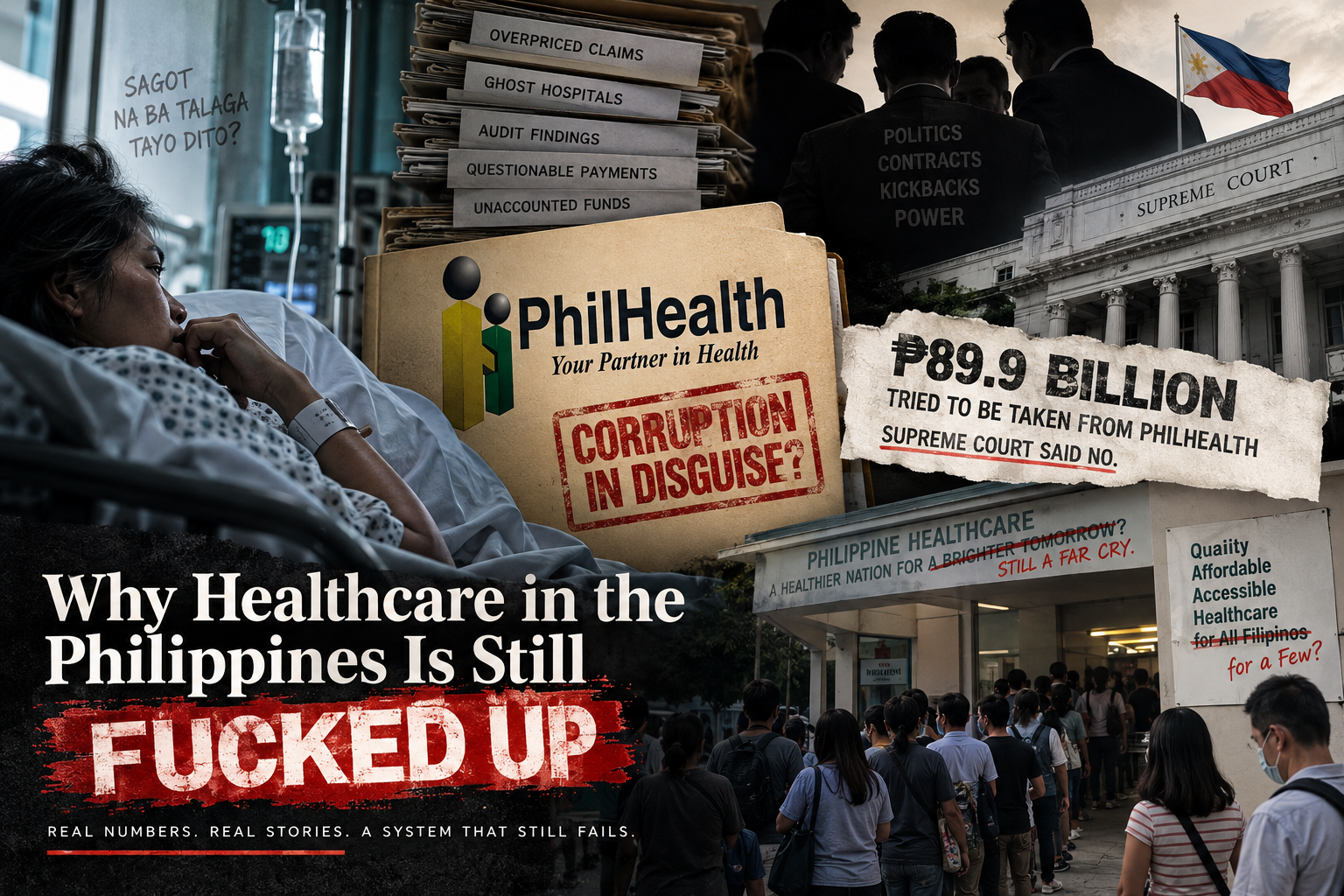
Why Healthcare in the Philippines Is Still Fucked Up
Why is Philippine healthcare still failing patients? Explore PhilHealth, high out-of-pocket costs, audit failures, access gaps, and the limits of universal healthcare.
Philippine Healthcare • Fact-Checked
PhilHealth promises universal protection. Filipinos still pay enormous amounts from their own pockets, auditors have repeatedly found serious control failures, and the Supreme Court had to stop the government from taking billions from the national health insurance fund.
Updated September 2026 • All monetary figures are Philippine pesos.
A note before we begin
This article is critical of PhilHealth and the Philippine healthcare system, but it does not claim that every PhilHealth employee is corrupt or that every controversy involving the agency was criminal corruption. Where something was an allegation, it is called an allegation. Where auditors, investigators or the Supreme Court made a finding, that finding is identified directly.
Start with the number that actually matters: 41.2%
The Philippines supposedly has universal health coverage. Yet in 2025, 41.2% of the country's current healthcare spending still came directly out of household pockets.[1]
Government schemes and compulsory contributory financing accounted for 46.5%. Total Philippine health expenditure reached approximately ₱1.87 trillion, equivalent to 6.7% of GDP.[1]
Those figures expose one of the central contradictions in Philippine healthcare. We have a national health insurance system, a Universal Health Care law and mandatory contributions from millions of workers, yet households still finance an enormous share of healthcare themselves.
The reality
Having a PhilHealth number is not the same thing as being financially protected when somebody in your family gets seriously sick.
Universal membership does not automatically mean universal healthcare
Republic Act No. 11223, the Universal Health Care Act, automatically includes Filipinos in the National Health Insurance Program and provides immediate entitlement to benefits.[2]
At the same time, the statutory premium schedule for direct contributors reached 5% of monthly basic salary, with a ₱10,000 income floor and ₱100,000 ceiling in 2025.[2]
There is nothing inherently corrupt about compulsory social insurance. Countries around the world pool money so healthy and higher-income members help finance care for people who become sick.
The legitimate question is what Filipinos receive in exchange.
When households are still responsible for more than two-fifths of current health expenditure, the problem is not merely whether people technically have insurance. The question is whether that insurance provides enough financial protection when illness actually happens.[1]
Insurance also cannot fix a hospital or clinic that does not exist
Healthcare access is not just a financing problem.
Department of Health planning documents reported that around half of the population lacked access to a primary-care facility within 30 minutes at the 2020 baseline. Only 21% of provinces had adequate ambulatory primary-care facilities in the 2022 baseline used by the DOH.[3]
That means the problem begins before anybody submits a PhilHealth claim. Insurance is much less useful if the nearest properly equipped facility is too far away, understaffed or unable to provide the treatment a patient needs.
There has been progress. By May 2026, PhilHealth reported that 33.2 million Filipinos had been reached through 4,287 accredited YAKAP primary-care clinics. By August 31, 2026, PhilHealth's accreditation database listed 4,587 YAKAP clinics nationwide.[13]
That expansion matters. It also illustrates how much infrastructure and primary-care development was still necessary years after the UHC law was enacted.
Then there is PhilHealth's record on fraud control
This is where criticism stops being merely anecdotal.
A Commission on Audit performance audit of the National Health Insurance Program examined PhilHealth's systems for preventing and detecting improper payments. COA concluded that the controls were deficient and underperforming.[4]
Consider its Medical Prepayment Review.
From March 2019 through June 2020, 878,876 claims were supposed to undergo the review. Only 252,408 were actually reviewed. According to COA, 443,162 claims were paid without undergoing the required prepayment review.[4]
The post-payment audit system was not much more reassuring.
COA reported that PhilHealth had paid approximately 61.25 million claims from 2014 through June 2020. Of the 16.48 million claims that policy required to undergo medical post-audit, only about 3.20 million had actually been audited. The backlog reached approximately 13.54 million claims.[4]
That is not proof that every unchecked claim was fraudulent. It is proof that a system responsible for enormous amounts of public and member money did not consistently perform the controls designed to detect improper payments.
The pandemic reimbursement controversy was not imaginary either
During the COVID-19 pandemic, PhilHealth used its Interim Reimbursement Mechanism or IRM to advance money to healthcare institutions.
PhilHealth's own 2020 annual report, incorporating audit findings, recorded approximately ₱14.971 billion in IRM releases to 711 healthcare institutions.[5]
Auditors found problems with the policy and its implementation. For 488 healthcare institutions that received ₱10.651 billion, COA's recalculations indicated excessive releases ranging from approximately ₱81.5 million to ₱2.208 billion, depending on which data were properly used to calculate allowable amounts.[5]
COA also found that the governing PhilHealth circular had not been sufficiently designed for the COVID-19 situation and that this contributed to noncompliance with rules governing the processing and release of the funds.[5]
An inter-agency task force led by the Department of Justice subsequently concluded that the evidence supported a reasonable conclusion that wrongful acts or omissions had been committed by certain key PhilHealth officers. The NBI filed graft, malversation and other complaints with the Office of the Ombudsman against several former and serving officials in connection with IRM transactions.[6]
Important distinction: filing a criminal complaint is not the same thing as a criminal conviction. The existence of those complaints is a fact; guilt still requires the appropriate legal process.
What about the famous “₱15 billion stolen” claim?
This needs to be stated accurately because the number is constantly repeated online as though it were an audited finding.
During the 2020 Senate investigation, former PhilHealth anti-fraud officer Thorrsson Montes Keith alleged that roughly ₱15 billion had been lost through fraud or corruption. The Senate record confirms that the allegation was made.[7]
But that does not make ₱15 billion a judicially proven theft figure or a final COA determination.
The defensible criticism of PhilHealth does not need that number to be exaggerated. The documented audit failures are serious enough on their own.
Then the government tried to move ₱89.9 billion out of PhilHealth
In 2024, the Department of Finance directed PhilHealth to remit ₱89.9 billion in what the government characterized as excess, unused or idle funds to the National Treasury.
PhilHealth transferred ₱60 billion before the Supreme Court stopped the remaining ₱29.9 billion.[8]
The government defended the move by arguing that much of the transferred money was used for health and other social-development spending.
But on December 3, 2025, the Supreme Court unanimously ordered the ₱60 billion returned to PhilHealth and permanently prohibited transfer of the remaining ₱29.9 billion.[8]
The Court's majority declared the relevant 2024 General Appropriations Act provision and Department of Finance circular void. It found grave abuse of discretion and held that the budget provision was an unconstitutional rider.[8]
The Court further ruled that taking the supposed excess funds in this manner was incompatible with the Universal Health Care Act's rules for PhilHealth reserves and undermined the role of those funds in achieving universal healthcare and protecting the right to health.[8]
This point needs precision.
The Supreme Court ruled the transfer scheme unconstitutional. It did not rule that the ₱60-billion transfer was criminal corruption. The Court's press briefer also noted the view that criminal liability did not attach to the Finance Secretary, who acted in good faith in implementing the provision.
That does not make the episode insignificant.
A government health insurer existed to pool money for healthcare. Tens of billions were removed from it through a mechanism the Supreme Court later struck down. Whatever political label one chooses, that is an extraordinary governance failure.
The ₱60 billion was ultimately restored to PhilHealth in 2026. PhilHealth announced that the funds had been returned from the National Treasury in May 2026.[9]
And the accounting problems did not disappear after 2020
The Commission on Audit issued a qualified opinion on PhilHealth's 2024 financial statements. A qualified opinion does not mean that every number in the accounts is false. It means auditors identified material matters that prevented them from giving an unmodified opinion.[10]
Among other issues, COA said it could not establish the completeness and accuracy of data used for PhilHealth's insurance-contract liabilities.
Auditors also identified weaknesses involving contribution and receivable records and said ₱162.099 billion in online Statement of Premium Account transactions for 2024 could not be validated because of database availability and system-access limitations.[10]
COA separately raised concerns about the reliability of recorded benefit, processed-claim and claims-in-settlement balances because of weaknesses in claims accounting.[10]
These are not sexy corruption headlines. They are arguably more important: if a national insurer cannot consistently produce fully auditable contribution and claims data, oversight becomes harder and mistakes, inefficiency and fraud become more difficult to detect.
Ordinary hospitals also got trapped in the bureaucracy
In March 2025, PhilHealth itself announced that it would reprocess 1.1 million previously denied claims involving hospitals.
PhilHealth said that, from 2018 through 2024, approximately 30% of denied claims had been rejected because they were filed late. The agency emphasized that many were administrative cases rather than fraudulent claims.[11]
Again, this is not proof of corruption.
It is evidence of a system capable of generating enormous administrative friction between the country's national health insurer and the facilities actually treating patients.
To be fair, PhilHealth has also expanded benefits
A fact-based criticism has to acknowledge improvements too.
PhilHealth raised selected case rates by 30% in 2024 and followed this with a further 50% adjustment covering almost 9,000 benefit packages beginning in January 2025. PhilHealth said the two adjustments effectively doubled many rates that had remained unchanged since 2014.[12]
In April 2026, PhilHealth reported that it had paid ₱300.45 billion in benefits during the previous year, an 81.72% increase.[13]
Primary-care enrollment has expanded through YAKAP, new medicine benefits have been introduced, and coverage for several high-cost conditions has increased.
Those are real developments. Pretending otherwise would be dishonest.
But neither should benefit expansion be used to erase documented governance, auditing and financial-protection problems.
So, is PhilHealth “corruption in disguise”?
If that sentence is intended to mean that every contribution is stolen or that PhilHealth provides no useful healthcare benefits, the facts do not support it.
PhilHealth pays hundreds of billions of pesos in benefits, and millions of Filipinos genuinely use those benefits.
If the phrase instead describes why people have lost trust in the institution, the record explains that anger:
- Households still paid 41.2% of current health expenditure directly from their own pockets in 2025.[1]
- COA documented major weaknesses in systems intended to prevent and detect improper claims payments.[4]
- Pandemic-era IRM releases generated serious audit findings and criminal complaints against officials.[5][6]
- COA issued a qualified opinion on PhilHealth's 2024 financial statements and identified significant data, accounting and auditability problems.[10]
- The government transferred ₱60 billion away from PhilHealth using a mechanism that the Supreme Court later struck down, while another ₱29.9 billion transfer was permanently blocked.[8]
- PhilHealth later acknowledged 1.1 million denied hospital claims that would need to be reprocessed because of late-filing issues.[11]
You do not need conspiracy theories to conclude that something is badly wrong.
You only need to read the government's own statistics, PhilHealth's own reports, the Commission on Audit's findings and the Supreme Court's decision.
The bigger problem is not one scandal. It is the structure.
Philippine healthcare has a strange combination of compulsory insurance, substantial public spending, private hospital dependence, uneven local healthcare capacity and persistently high household spending.
In that environment, corruption is only one possible way public money can fail patients.
Money can also be lost in inefficient processes, weak auditing, bad payment design, inadequate primary care, administrative delays, poor data systems, fragmented governance and policies that send funds somewhere other than where health law intended them to go.
For the patient trying to find money for a hospital bill, the distinction between corruption and catastrophic incompetence may feel academic.
Universal healthcare should mean that getting sick is a medical problem, not a financial catastrophe.
Until Philippine healthcare reliably achieves that, calling the system “universal” will remain far more impressive on paper than it feels at the hospital cashier.
Sources
- Philippine Statistics Authority, Philippine National Health Accounts, 2025 health expenditure release, June 18, 2026.
- Republic Act No. 11223 / PhilHealth Universal Health Care guidance and PhilHealth premium contribution schedule.
- Department of Health primary-care access studies and National Objectives for Health 2023–2028.
- Commission on Audit, Performance Audit Report: National Health Insurance Program, 2020.
- PhilHealth 2020 Annual Report, including Commission on Audit findings on the Interim Reimbursement Mechanism.
- Department of Justice / Task Force PhilHealth and National Bureau of Investigation complaints relating to 2020 PhilHealth transactions.
- Senate of the Philippines records concerning the 2020 PhilHealth inquiry and the ₱15-billion whistleblower allegation.
- Supreme Court of the Philippines, Pimentel et al. v. House of Representatives et al., G.R. Nos. 274778, 275405 and 276233, decision dated December 3, 2025.
- PhilHealth announcement on the restoration of ₱60 billion from the National Treasury, May 2026.
- Commission on Audit Independent Auditor's Report on PhilHealth's 2024 financial statements.
- PhilHealth announcement on reprocessing 1.1 million denied hospital claims, March 6, 2025.
- PhilHealth Circular No. 2024-0037 and January 2025 announcement on the 50% adjustment of selected case rates.
- PhilHealth 2026 releases on benefit payments and YAKAP expansion; PhilHealth Status of Accreditation as of August 31, 2026.
Editorial standard: This article distinguishes allegations, criminal complaints, audit findings and final court rulings. Figures should be updated if newer official government data become available after September 2026.