THE PHYSIOPH JOURNAL
AI & Robotics in Physiotherapy Philippines: Benefits and Risks
Explore how AI and robotics are changing physiotherapy in the Philippines—the evidence, benefits, risks, costs, privacy issues, and future of rehabilitation.
AI and Robotics in Physiotherapy: What Could They Mean for Rehabilitation in the Philippines?
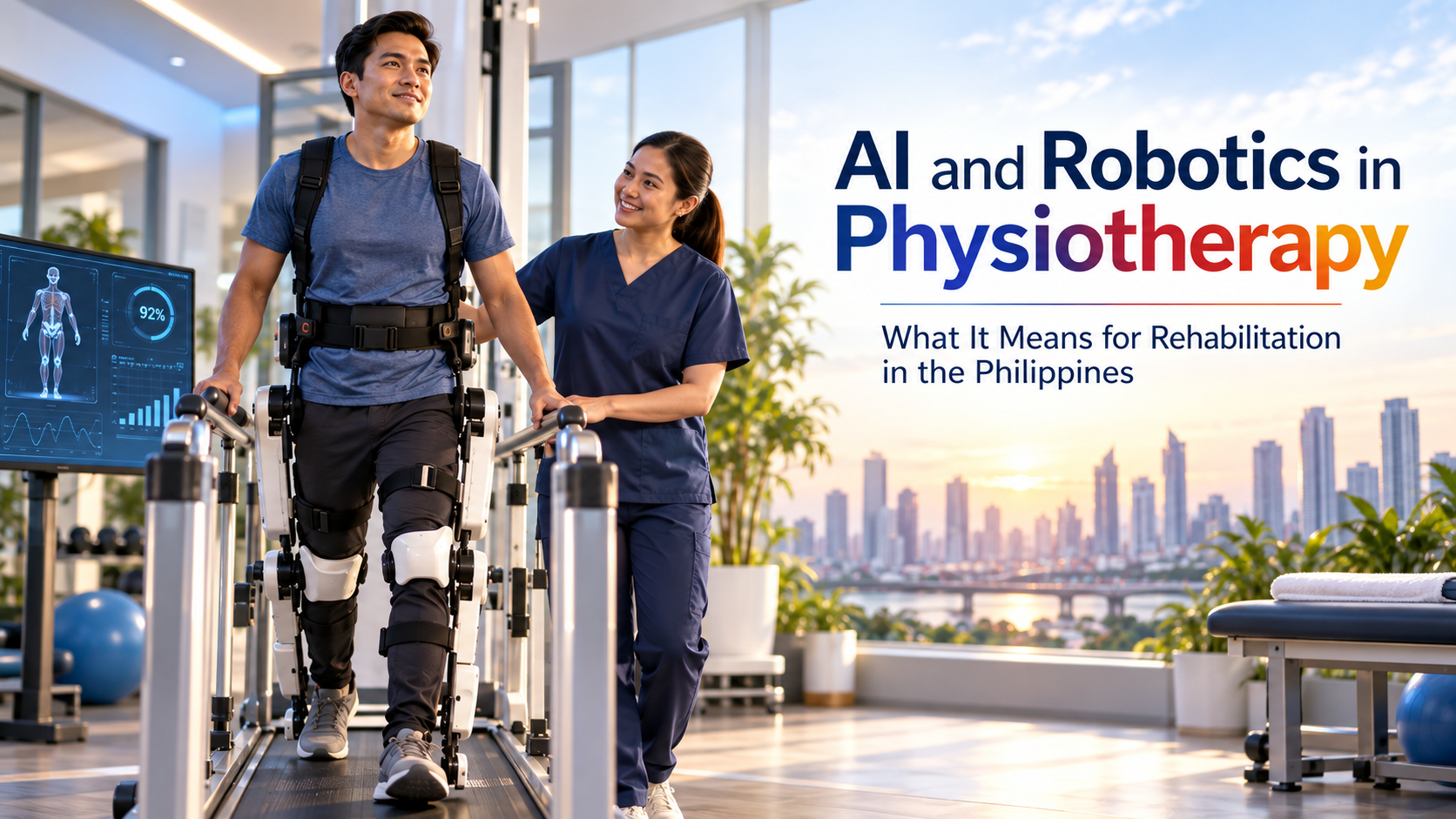
Imagine trying to relearn how to walk after a stroke. A movement that used to happen without thought—lifting a foot, shifting weight, keeping balance—can suddenly require enormous concentration and repeated practice.
Now imagine a robotic system supporting part of your body weight while helping guide each step. Sensors measure how you move. Software records your performance. An artificial intelligence system may analyze those measurements and look for patterns that can help clinicians adjust rehabilitation.
It sounds futuristic.
But this is no longer purely a vision of the future.
Artificial intelligence, wearable sensors, computer vision, rehabilitation robots and robotic exoskeletons are already being investigated and used in different areas of rehabilitation around the world.
For the Philippines, the subject deserves particular attention because rehabilitation is not a small healthcare issue.
Why This Matters in the Philippines
Stroke alone gives us a reason to pay attention.
According to the Philippine Statistics Authority, 68,729 registered deaths in the Philippines in 2024 were attributed to cerebrovascular diseases, including stroke. They represented approximately 9.8% of registered deaths and were the country's third-leading cause of death.[1]
Death statistics, of course, tell only part of the story. People who survive stroke may experience weakness, impaired balance, difficulty walking, loss of hand function and other disabilities that can require rehabilitation.
At the same time, the Philippine rehabilitation workforce has historically been relatively small. A Philippine health-workforce study analyzing national data from 2010 to 2019 reported a physical-therapist density of about 1.54 physical therapists per 10,000 people during that period.[2]
That figure should not be treated as the current 2026 workforce count—it comes from historical workforce data. But it illustrates a longstanding capacity problem that makes technologies capable of supporting rehabilitation worth investigating.
The challenge is global as well. The World Health Organization estimates that about 2.4 billion people worldwide live with a condition that could benefit from rehabilitation—roughly one in three people.[3]
So the important question is not simply:
“Can we put robots and AI inside rehabilitation clinics?”
A much more useful question is:
“Can these technologies produce meaningful improvements for patients, safely and affordably, without turning healthcare into technology for technology's sake?”
First, AI and Rehabilitation Robots Are Not the Same Thing
The terms are often mixed together, but they describe different technologies.
Artificial intelligence in rehabilitation
AI generally refers to computer systems that perform tasks such as recognizing patterns, making predictions, classifying information or adjusting decisions based on data.
In rehabilitation research, AI has been studied for applications including:
- analysis of movement and gait;
- prediction of rehabilitation outcomes;
- monitoring patients using wearable sensors;
- computer-vision analysis of exercises;
- adjustment of rehabilitation difficulty;
- processing clinical information;
- controlling or adapting robotic rehabilitation devices.
Importantly, an AI rehabilitation system does not have to contain a robot. A smartphone camera analyzing an exercise, for example, may use AI without involving any robotic hardware.
Robotic rehabilitation
Rehabilitation robots are physical machines designed to assist, resist, guide or repeatedly reproduce movements during therapy.
Examples include:
- robotic devices that support arm and hand training after stroke;
- robot-assisted gait-training machines;
- lower-limb robotic exoskeletons;
- devices that provide controlled resistance or assistance during movement;
- robotic systems combined with sensors and computer feedback.
Some rehabilitation robots incorporate AI or machine-learning algorithms. Others operate using conventional control systems.
That distinction matters because evidence about “AI” should not automatically be interpreted as evidence about “robots,” and evidence about one robotic device should not automatically be generalized to every rehabilitation robot.
What Does the Scientific Evidence Actually Say?
This is where the story becomes more interesting—and more complicated.
The evidence does not support the idea that rehabilitation robots are universally better than conventional physiotherapy.
But neither does it support dismissing them as a gimmick.
Robot-assisted arm rehabilitation after stroke
A major 2025 umbrella review published in Stroke examined systematic reviews of robot-assisted upper-limb rehabilitation after stroke. The researchers combined evidence originating from hundreds of randomized controlled trials.[4]
They found statistically significant improvements in motor recovery when robot-assisted therapy was compared with conventional therapy and when robotic treatment was added to conventional treatment.
There was an important catch.
The average improvements did not reach previously established minimum clinically important difference thresholds.[4]
That distinction is crucial.
A difference can be statistically detectable without being large enough for patients to experience it as an important functional change.
The same review found that robot-assisted therapy added to conventional therapy produced significant improvements in activities of daily living, while findings for some other outcomes were less convincing.[4]
In other words, the evidence is encouraging—but it is not a license to claim that a robot automatically produces superior recovery.
Robot-assisted walking after stroke
Evidence surrounding robotic gait training is also substantial.
A 2025 systematic review and meta-analysis examined 23 randomized controlled trials involving 907 participants. When robot-assisted gait training was combined with conventional rehabilitation, the analysis reported significant improvements in gait function, gait speed, balance and activities of daily living compared with conventional rehabilitation alone.[5]
However, not every review has found improvements in every walking measurement.
A separate meta-analysis involving 27 publications and 1,167 patients found improvements in measures including the six-minute walk test, temporal symmetry and functional ambulation, but did not find significant differences for measures such as gait speed and cadence.[6]
This apparent inconsistency is one of the most important lessons in rehabilitation technology.
Results depend on the patient population, type of robot, treatment protocol, stage of recovery, amount of therapy and outcome being measured.
Where AI Fits Into the Picture
AI may eventually become just as important as the mechanical robot itself.
A major living systematic review of AI in rehabilitation illustrates how quickly this research area is growing.
Its first release identified 240 relevant studies published between late 2014 and the end of 2024. A subsequent update brought the cumulative total to 335 studies through May 31, 2025.[7]
The studies included applications in neurological and orthopedic rehabilitation, with researchers investigating intervention, assessment, prognosis, diagnosis and monitoring.
AI was frequently combined with technologies such as:
- wearable sensors;
- robotic systems;
- surface electromyography;
- mobile applications;
- electroencephalography;
- movement-analysis systems.
That sounds impressive.
But one statistic from the updated review should prevent anyone from becoming carried away by the excitement.
Only 13.7% of the studies reported external validation, while explainability was reported in 28.4%.[7]
External validation matters because an AI system that performs well on data from the hospital, laboratory or population where it was developed may not necessarily perform equally well on different patients somewhere else.
For the Philippines, this question becomes especially important.
An algorithm developed primarily from patients in another country should not simply be assumed to perform identically among Filipino patients without appropriate validation.
The Advantages of AI and Robotics in Physiotherapy
1. They can deliver highly repetitive training
Rehabilitation commonly requires repeated, task-specific movement. Robotic systems can perform controlled movements again and again while providing consistent assistance or resistance.
This makes them particularly attractive for neurological rehabilitation, where researchers have investigated high-intensity and high-frequency training after conditions such as stroke.
A machine does not become physically tired in the same way a therapist's arms do while assisting hundreds of repeated movements.
That does not mean the therapist disappears. It means some of the repetitive mechanical work can potentially be supported by equipment.
2. They can measure movement objectively
Robotic systems and digital rehabilitation devices can collect quantities that are difficult to estimate precisely by observation alone.
Depending on the device, measurements may include:
- joint movement;
- speed;
- force;
- movement symmetry;
- number of repetitions;
- movement trajectories;
- muscle activity;
- walking characteristics.
A 2024 systematic review of physical rehabilitation robotics highlighted precision, repeatability and continuous monitoring among the major advantages of these systems.[8]
For clinicians, objective measurements can provide another source of information for tracking rehabilitation progress.
3. AI can analyze large amounts of rehabilitation data
A therapist can observe a patient walking.
A sensor-equipped system can potentially record hundreds or thousands of measurements from that same movement.
Machine-learning algorithms can then search those measurements for patterns associated with performance, impairment or recovery.
This ability is one reason AI research has expanded into areas such as gait analysis, outcome prediction and movement classification.
4. Some systems can adapt assistance to the patient
Modern rehabilitation devices can be designed to alter the amount of assistance or resistance according to performance.
AI and adaptive control techniques are being researched to make this adjustment increasingly individualized.
The goal is straightforward: provide enough assistance for a patient to complete useful movement without unnecessarily doing all of the work for them.
5. Digital rehabilitation could help extend monitoring outside clinics
AI does not always require a multimillion-peso machine in a hospital.
Wearables, smartphones, cameras and remote rehabilitation platforms are also areas of active research.
That is particularly interesting for a country made up of more than 7,000 islands, where geography itself can become a barrier to repeated in-person healthcare.
However, remote rehabilitation is only useful when patients have suitable devices, connectivity, digital literacy, appropriate clinical supervision and a system that has actually been validated for its intended purpose.
The Disadvantages and Risks
This is the part that deserves just as much attention as the benefits.
1. “Statistically significant” does not always mean “life-changing”
The 2025 upper-limb stroke umbrella review provides a perfect example.
Robot-assisted therapy produced statistically significant improvements, but the average motor-function gains did not cross established minimum clinically important difference thresholds.[4]
That does not mean the treatment had no value.
It means headlines such as “robots dramatically improve stroke recovery” would go beyond what the evidence establishes.
2. AI evidence is still maturing
Hundreds of AI rehabilitation studies exist, but methodological limitations remain.
The updated systematic mapping review found that randomized controlled trials remained underrepresented and external validation remained uncommon.[7]
This matters because machine-learning systems can appear impressive during development yet perform less reliably when used with new hospitals, different equipment or different patient populations.
3. Rehabilitation robots can be expensive
Cost is one of the most obvious obstacles for the Philippines.
The 2024 systematic review of rehabilitation robotics identified high acquisition and maintenance costs, operational complexity, staff training requirements and limited accessibility as barriers to adoption.[8]
Advanced robots contain motors, sensors, actuators, electronics and specialized software. They also require maintenance, calibration, trained personnel and appropriate clinical infrastructure.
The purchase price therefore does not represent the entire cost of owning the technology.
For a health system where rehabilitation resources are already unevenly distributed, expensive technology could improve treatment in well-funded centers while remaining inaccessible elsewhere.
That is a real equity problem.
4. Hardware and software can fail
Rehabilitation robots physically interact with people whose movement may already be impaired.
Safety is therefore not optional.
The robotics systematic review identified potential risks from hardware failures, sensor problems, software bugs, incorrect setup and human operating errors.[8]
Proper maintenance, fail-safe systems, staff training and clinical supervision are essential.
5. Health data are sensitive data
AI rehabilitation can generate an enormous amount of personal information.
A rehabilitation platform might collect:
- video of the patient;
- walking patterns;
- joint movements;
- medical history;
- exercise performance;
- location or device information;
- physiological measurements.
Under the Philippines' Data Privacy Act of 2012 (Republic Act No. 10173), information about an individual's health is classified as sensitive personal information.[10]
That means clinics and technology providers cannot treat rehabilitation data like ordinary application analytics.
Questions about consent, collection, storage, access, cybersecurity, sharing and deletion of patient information are part of the healthcare problem—not merely an IT problem.
6. An AI model can inherit problems from its data
WHO guidance on artificial intelligence for health specifically identifies risks involving bias, inequity, privacy, accountability and transparency.[9]
If a rehabilitation algorithm was trained on data that poorly represent older patients, people with severe disabilities, particular ethnic populations or other groups, its performance may not generalize equally to everyone.
This is another reason local evaluation matters.
7. Explainability remains a problem
If an AI system tells a clinician that a patient has a certain risk or should receive a particular intervention, an obvious question follows:
Why?
The latest systematic mapping review found that explainability was still inconsistently implemented across rehabilitation-AI research.[7]
In healthcare, an unexplained recommendation carries a different level of consequence from a movie or shopping recommendation.
Will Robots Replace Filipino Physical Therapists?
Current research does not establish that robots can replace physical therapists across the complete rehabilitation process.
Most clinical research evaluates robots within a rehabilitation program—either comparing robot-assisted therapy with conventional therapy or adding robotic treatment to existing rehabilitation.
A physiotherapist's work also extends beyond producing repetitive movement.
Clinical rehabilitation includes assessment, goal setting, selecting appropriate interventions, monitoring symptoms, modifying treatment, evaluating safety, educating patients and coordinating care.
WHO's principles for AI in health explicitly state that human autonomy should be protected and humans should remain in control of healthcare systems and medical decisions.[9]
The more evidence-based interpretation is therefore not “robot versus therapist.”
It is:
Which parts of rehabilitation can technology perform or support effectively, and which decisions still require trained healthcare professionals?
A Philippine Hospital Should Ask Hard Questions Before Buying the Technology
A futuristic demonstration is not the same thing as evidence.
Before an AI or robotic rehabilitation system is adopted, several factual questions deserve answers:
- What exact medical purpose does the system have?
- Has it been tested in randomized or prospective clinical studies?
- How many patients were included in those studies?
- Were the improvements clinically meaningful or only statistically significant?
- Was the AI externally validated using an independent population?
- Does the validation population resemble the patients who will use it in the Philippines?
- What happens when the software or hardware fails?
- How much will calibration, servicing and replacement parts cost?
- What training is required for Filipino physical therapists and biomedical personnel?
- Where is patient data stored, and who can access it?
- What regulatory authorization applies to the device or software?
The last question is increasingly relevant.
The Philippine Food and Drug Administration already regulates medical devices, and in 2025 it released draft guidance specifically addressing medical-device software, including artificial-intelligence medical devices and software used for medical purposes.[11]
The existence of such regulatory work reflects a simple reality: healthcare AI cannot be treated like an ordinary consumer application.
Where the Biggest Opportunity May Actually Be
The most valuable rehabilitation technology for the Philippines may not necessarily be the most impressive robot.
A sophisticated exoskeleton installed in one major urban hospital can help only the patients who can reach and afford access to that facility.
Meanwhile, less dramatic technologies—validated movement-analysis software, wearable sensors, remote monitoring tools or affordable assistive rehabilitation devices—could potentially be deployed more widely.
Which approach provides better value cannot be answered by excitement alone. It requires Philippine clinical studies, cost-effectiveness analysis, infrastructure assessment and careful evaluation of who actually gains access.
This is where the emotional excitement surrounding AI has to meet the discipline of evidence.
Because the goal of rehabilitation is not to own impressive technology.
The goal is improved human functioning.
So, Is AI and Robotics the Future of Physiotherapy?
They are clearly becoming part of rehabilitation research and clinical technology.
There is credible evidence that robot-assisted rehabilitation can improve selected outcomes, particularly in areas such as post-stroke gait and upper-limb training. There is also rapidly expanding research into AI for movement analysis, prediction, monitoring and personalized rehabilitation.
But the evidence contains important limits.
Some improvements are modest. Results vary between technologies and patient groups. AI studies often lack external validation. Explainability remains incomplete. Robotic systems can be expensive. Equipment needs maintenance and trained operators. Patient data require strong protection.
For the Philippines, those disadvantages cannot be treated as footnotes.
We have a country with substantial rehabilitation needs, geographic barriers, limited historical rehabilitation-workforce density and major differences in healthcare resources between communities.
Technology could become part of the solution.
It could also widen inequality if advanced rehabilitation remains concentrated only in institutions capable of purchasing it.
That is why the most important question is not whether a machine looks futuristic.
It is whether the machine helps a real patient achieve a meaningful outcome—and whether Filipino patients can safely, fairly and realistically gain access to it.
AI can calculate.
Robots can repeat movements with extraordinary precision.
But healthcare still has to answer the human question:
Did this technology actually help this person live better?
References and Research Sources
- Philippine Statistics Authority. Vital Statistics: 2024 Causes of Death in the Philippines. Cerebrovascular diseases, including stroke, accounted for 68,729 registered deaths or 9.8% of registered deaths.
- Cocreation in Health Workforce Planning to Shape the Future of the Health Care System in the Philippines. Global Health: Science and Practice, 2022. Philippine health-workforce analysis using 2010–2019 data; reported physical-therapist density of approximately 1.54 per 10,000 population.
- World Health Organization. Global Estimates of the Need for Rehabilitation / Rehabilitation 2030. WHO estimates approximately 2.4 billion people globally live with conditions that could benefit from rehabilitation.
- Park JM, et al. Effects of Robot-Assisted Therapy for Upper Limb Rehabilitation After Stroke: An Umbrella Review of Systematic Reviews. Stroke. 2025;56(5):1243–1252. DOI: 10.1161/STROKEAHA.124.048183. PMID: 40115991.
- Effectiveness of Robot-Assisted Gait Training in Stroke Rehabilitation: A Systematic Review and Meta-Analysis. 2025. Analysis of 23 randomized controlled trials involving 907 participants. PMID: 40649182.
- How Robot-Assisted Gait Training Affects Gait Ability, Balance and Kinematic Parameters After Stroke: A Systematic Review and Meta-Analysis. 2024. Twenty-seven publications involving 1,167 patients. PMID: 38647534.
- Artificial Intelligence in Physical and Rehabilitation Medicine: First Update of the Living Systematic Mapping Review up to May 31st, 2025. Systematic evidence update covering 335 studies. PMID: 42678181.
- Banyai AD, Brișan C. Robotics in Physical Rehabilitation: Systematic Review. Healthcare. 2024;12(17):1720. DOI: 10.3390/healthcare12171720. PMID: 39273744.
- World Health Organization. Ethics and Governance of Artificial Intelligence for Health: WHO Guidance. 2021.
- Republic of the Philippines. Republic Act No. 10173 — Data Privacy Act of 2012. National Privacy Commission. Health information is included within the law's definition of sensitive personal information.
- Philippine Food and Drug Administration. Draft Guidelines on the Regulation of Medical Device Software, released for stakeholder comments in 2025. The draft includes provisions relating to Software as a Medical Device and Artificial Intelligence Medical Devices.
Medical note: This article discusses published research and health technology. It is educational information and does not replace an individual assessment or treatment plan from a licensed physician, physical therapist or other qualified rehabilitation professional.